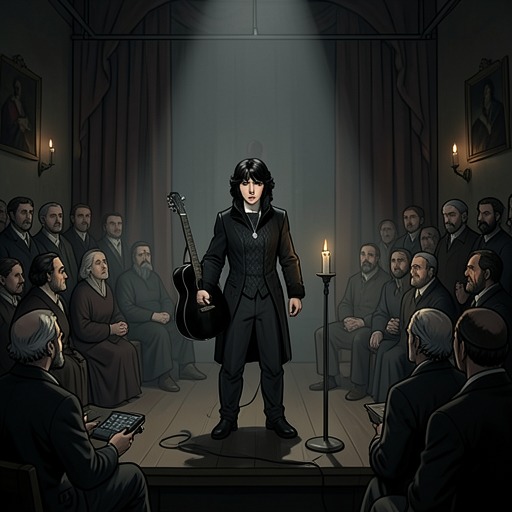
Quorthon
Lords of ChaosQuorthon, the stage name of Thomas Börje Forsberg, was the driving force behind Bathory, a Swedish group that helped define the sound and imagery of modern Black Metal. The band never played a public live concert, yet its records traveled widely through the underground: from a hurried, abrasive first album to expansive works centered on Norse heathen themes. Across that transformation, Quorthon moved between teenage provocation, deliberate ambiguity, and a growing musical ambition, leaving a blueprint that later Scandinavian Black Metal would draw upon.
Identity and Beginnings
Bathory took its name from Erzebet Bathory, the Hungarian noblewoman tried for the murder of hundreds of young girls and alleged to have bathed in their blood to preserve her beauty. The name may have come directly from Venom’s song “Countess Bathory,” on the album Black Metal; Bathory’s early sound and appearance also owed much to Venom. The band’s identity thus began in an international metal vocabulary of horror and extremity, even as its later work would turn toward Northern European history and myth.
Quorthon was about fifteen when he began trying to get his band heard. In January 1984, while helping a record company listen to new groups during a metal boom associated with the New Wave of British Heavy Metal, he learned that the company planned a compilation of five or six Swedish bands. He asked the label to listen to his group, presenting it as an exciting new kind of Heavy Metal. The compilation, Scandinavian Metal Attack, generated an unexpectedly strong response: Quorthon later recalled that 85 to 90 percent of the fan mail sent to the company concerned Bathory’s songs. The label then urged him to reform the band, write more material, and record a full-length album that summer.
From Raw Noise to an Underground Force
Bathory’s first album was made in circumstances that became part of its sound. Quorthon said the band had seemed so rough that he doubted it would return to a studio; the record was completed in two and a half days on a budget of only a few hundred dollars. Its noisy effects, distortion, fast rhythm section, and barked, difficult-to-decipher vocals produced a sound markedly more extreme than most metal being made in 1984. The limitations did not keep the record small in influence: it made a major impression on the underground metal scene. Bathory’s refusal ever to perform publicly makes that influence especially notable; its audience was built through recordings rather than live appearances.
The early lyrics drew on black magic and Satanism in the manner of Venom, but Quorthon later described their seriousness as bound up with adolescence. The songs were initially horror stories rather than a worked-out message. He recalled a youthful fascination with the subject, a desire to rebel against adults, and the use of inverted crosses to signal a preference for Satan over Christ. In retrospect, he recognized that a younger and more innocent mind could grant horror stories more reality than they possessed. His account does not erase the force the material had for its audience; instead, it distinguishes the intensity of the performance from the depth of any doctrine behind it.
The Ásatrú Turn
The Return... (1985) and Under the Sign of the Black Mark (1987) marked a gradual change: the music slowed, the songs became more elaborate, and the themes grew more subtle and ambiguous than those of the first records. With Blood Fire Death in 1988, that development became a pronounced change of imaginative world. The cover replaced the earlier B-movie horror imagery with a mythic battle scene: Valkyries on black horses and Thor above a warrior. Its imagery helped point extreme metal toward a Northern European past rather than simply extending Satanic horror.
On Hammerheart, the musical transformation became still more expansive. Many songs ran to about ten minutes; the vocals were clearly sung and supported by choral passages, and Richard Wagner was acknowledged in the credits. Its romantic cover painting, “A Viking’s Last Journey,” depicted a nobleman’s ship burial, with the longship set alight and sent out to sea. The book notes the irony that Norwegian listeners drawn to this imagined past would soon take real firebrands into their own criminal acts. That contrast is not evidence that Quorthon directed or endorsed those acts; it shows how an album’s historical imagery could be taken up and transformed by a later scene.
The final record in Bathory’s Ásatrú trilogy, Twilight of the Gods (1991), leaned further into European classical composition and Nietzschean warnings about modern spiritual decline. Quorthon also used the song “Under the Runes” to provoke discussion of Sweden’s pre-Christian past. He presented its central argument as a defense of a place for his father’s gods in public debate, and said he wrote the lyrics so that listeners could read them as a Second World War song. That ambiguity was strategic: he expected the apparent wartime reference to attract attention, giving him repeated opportunities to explain the song’s intended subject.
Symbols, Ambiguity, and Legacy
The visual language around Bathory also carried political associations. Hammerheart featured a sunwheel cross on its back cover, a symbol used by radical right-wing organizations. Quorthon said the emblem also signified archaeology in Sweden and that he had not considered its different meaning in Germany. He likewise described the original black, white, and red colors planned for the logo and titles as unconsidered; after the response, they were changed to gold. His explanation records his stated position, while the book questions whether he could have been unaware of the potency of such imagery. The discrepancy between claimed intent and public meaning remains part of Bathory’s legacy.
Taken together, Bathory’s first six albums encompassed a wide range of elements later associated with Scandinavian Black Metal: frenzied noise and melodic orchestral scale, Satanic excess and explorations of ancient heathenism, European cultural references, and flirtation with fascist and National Socialist iconography. Quorthon’s importance lies not in a single fixed message but in the range he helped establish. The same catalogue could supply later musicians with raw extremity, mythic grandeur, historical identity, or deliberately provocative symbols. Its influence grew through this combination of musical change and interpretive openness, even as the meanings listeners attached to it exceeded any one account of what its creator intended.